What is dowsing?
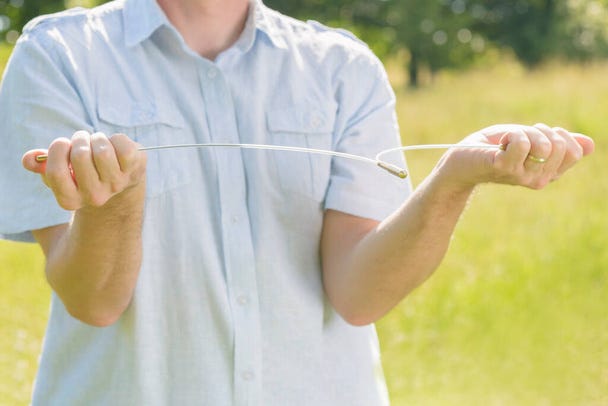
Dowsing is finding water underground using a forked stick, which will bend or turn when held over a water source.
A dusty, gravel road ran past our property when we lived off-grid at Core Hollow. Down that gravel road in an isolated and ramshackle farmhouse lived a man named Hobe Rolly.
Hobe might have been 50 years old. He looked aged to me then, but the hard work in those hills aged people fast.
Hobe was known as a bee man and a water witch. He would find a football-sized bee swarm hanging on a branch somewhere in the woods and convince the bees to follow him and occupy one of his luxury hives, hand-built and stacked alongside his house.
He was also a confirmed water witch, having found various underground streams of water for people to drill wells. They call it dowsing, now.
Drilling a water well today can cost anywhere from $27-$58 per foot.
If a geologist is called, that can cost about $2000 per day. So, Hobe had to be pretty accurate, even back then. Most of his clients couldn’t pay much for his services, either. The well we drilled was 212 feet deep up on the rocky ridge. Nevertheless, Hobe found water.
How did he do it? I don’t know. Hobe used a forked stick. Any tree will work but sticks from willows, witch hazel, and various fruit and nut trees seem to be the most popular. When the point of the forked stick bent way down in front of Hobe, there was water under there.
Geologists look for water by making a map of the terrain, and track where different kinds of rocks are located and research historical well data for the land. A geologist might use radar to reveal fractures in the ground where water might be flowing. They can get a printout that goes hundreds of feet below the surface and show where water might be located.
Dowsing is not a science, it is pre-science.
The earliest record of dowsing is thought to be in the northern Sahara Desert at Tassili n’Ajjer, in what is today Algeria. A cave painting dated to approximately 6000 BCE shows a human figure holding a curved stick. A century later, the Greek historian Herodotus described a man using a golden dowsing twig. By the Middle Ages, dowsing was already popular and controversial.
Martin Luther, the great German Christian reformer in the 16th century, condemned dowsing rods as in league with witchcraft.
Why?
The power of dowsing lies not in the devices used; dowsers say the devices channel the power, and it is out there, provided you quiet your mind and tune in.
It’s all bologna, right?
After all, it’s not solid science. Maybe dowsers are charlatans that prey upon vulnerable people, like Ouija board manipulators and faith healers.
In fact, Richard Dawkins, that paragon of skepticism and material science, investigated dowsing in 2007, determining that human belief in dowsing was no different than BF Skinner’s pigeons. When randomly fed, the pigeons soon began to believe that whatever movements they made before the food arrived, like turning clockwise, influenced the food’s arrival.
We might think a little deeper here, while not discounting the pigeon phenomena. Albert Einstein thought about it. He stated that dowsing was often “regarded on the same mystical level as astrology,” similarly to the way Martin Luther defined it.
With a little study, Einstein defined dowsing as a “way of using the human nervous system to detect factors that are unknown to us at the present time.”
Science would say that the solid world is just an illusion that our brains have bought into so we can navigate the world we live in. Our bodies, along with every other material thing in the universe are energy consisting of atoms, particles and subatomic particles and all the other stuff that isn’t really ‘stuff’ at all because it’s smaller even than an atom.
Where does that leave us? Like peeling away the skin of an onion, we peel away and find — there’s nothing there! We consist of energy; we live in a cosmic sea of energy.
Inside your body, you’re mostly a an empty series of electron clouds. Yet, nothing rests. Everything vibrates. Everything, in some subtle way, moves.
Many of those who hire a dowser say they don’t know how the curiosity works, only that it does.
“It’s just — insane,” says Steven Strong, a homeowner in Vermont’s Upper Valley. “I’m an engineer. I know physics. I can’t explain any of it.” But when the well on his property stopped producing about five years ago, the man Strong contracted to drill a new one had no idea where to put it. (Drillers don’t locate the water; they only strike it.) At the driller’s recommendation, Strong hired a dowser, a man from up north named Steve Herbert.
Strong watched the dowser stride around his property for a while. At about 50 feet from the dry well, the dowser pushed a stake into the ground. He confirmed that, if the driller would drill at that place completely vertically, he would hit a spring with water that gushed 25 gallons per minute of clean water.
“Honest to goodness, without any embellishment,” Strong said, “it was exactly spot-on. Not 23.5. Not 26. But 25 gallons a minute. I was there and I didn’t believe it, and the well driller was slack-jawed.”
“I’ll tell ya,” that driller, George Spear, said, “whatever it is, if someone ever unlocks the mystery, it’ll be amazing, because some people have it.”
According to the United States Geological Survey: ‘The natural explanation of “successful” water dowsing is that in many areas water would be hard to miss.’
To be honest, the lack of empirical evidence in testing of dowsing accuracy has failed to record statistical details like trial length or number of subjects, which makes a duplicate trial impossible to achieve.
However, empirical evidence can’t tell us what to do when it just doesn’t rain for a couple of years, like the weather in California today.
California may be fast returning to desert, and the farmland there is struggling to grow anything. Farmers have let 620,000 acres lie fallow, losing about $5.7 billion dollars. When farmers consider piping water from Alaska or building a billion- dollar desalination plant in San Diego, dowsing for wells sounds downright sensible.
Sharron Hope can find underground water. She uses a simple dowsing stick, like Hobe did in my neighborhood years ago, and can tell if she comes upon an underground spring because the stick moves in her hands. She can even guestimate how many feet to drill and how many gallons of water per minute the well might produce.
Scamming desperate people?
The woman is right so regularly that California excavators often call her before breaking ground.
But then — there’s an outer limits edge to dowsing.
Some of us, like me, have recognized portals to other dimensions right within our natural world. I don’t know if I dreamed this or it actually happened, but I entered a portal at Core Hollow, the wooded property I used to own. The landscape was incredibly bright and clear, the apple trees hanging with yellow-gold fruit, their leaves like green crystal droops. My old cat, long dead, came to meet me, His eyes were bright gold and his fur was stunningly lush and beautiful, unlike anything natural.
Leroy Bull, once the president of the American Society of Dowsers and still renowned, states, “When I dowse a property and they have kids and the portal’s down close to the ground, I ask them if they want me to zip it closed. And yeah,” he says, “I can do that.”
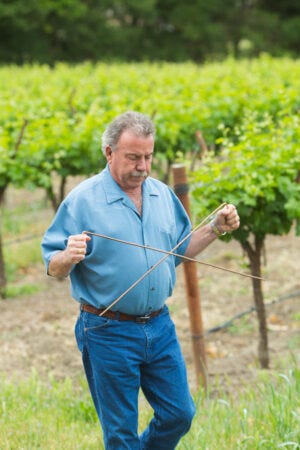
“There are wormholes. Wormholes are punctures in time. Overlaps,” he says. “They’re everywhere. Sometimes they’re in the sky; other times they’re in the bushes. Sometimes they’re closed; other times they’re open. And when they’re open, well, you can pass through them.”
Some say you have to be armed, either with the Holy Spirit or a .357 magnum, to enter portals. That’s because there’s another side to all of this, and that one is not always friendly. I’ll leave it at that.
It’s tough to discuss something outside of ‘normal’ experience like portals without people becoming defensive and labeling it nonsense. The same might go for dowsing.
Unlike Leroy Bull’s experience with what we call the ‘supernatural’, most dowsing is much more prosaic.
Deep Dive into Dousing states: “I know several professionals that occasionally use the technique to locate underground utilities such as water lines and electrical lines. They swear that it works, they don’t know how or why but swear that it does. Several utility companies in Canada do use divining rods occasionally.”
Prosaic proponents of dowsing claim that the rods may simply extend your personal magnetic field, which, in turn, responds to vibrational frequencies of the earth. Others say there is psychic energy involved, and it may also have something to do with the solar cycle and the spinning of planets.
On the other hand, experiments organized by the British Army and Ministry of Defense suggest that results obtained by dowsing are no more reliable than a series of guesses. McCarney, R et al, 2012
And, of course, the Amazing Randi would state that it was all BS.
According to dowser Sharron Hope, dowsing, like any skill, takes practice, and Hope freely admits she’s better now than when she first began. It’s a different kind of knowledge than empirically-tested, scientifically-proven information, but it’s hard-earned knowledge nonetheless.
She speaks to one of her clients, “There’s a water vein under here.”
“How deep?” asks Khamsing, who came to the US from Laos 30 years ago. He needs a well, but it’s going to be pricier to drill than he’d originally planned.
“I can give you an estimate,” Hope says.
“Please. I don’t have much money left.”
Hope dowses Khamsing’s property for $250.
When the driller shows up, he’ll make a hole that produces two to four gallons a minute, just as Hope predicts.
Anne Lafferty, #waterwitching#dousing#openportals